Webhooks API
Create and manage webhook subscriptions to receive real-time notifications when events occur in CronDB.
tip
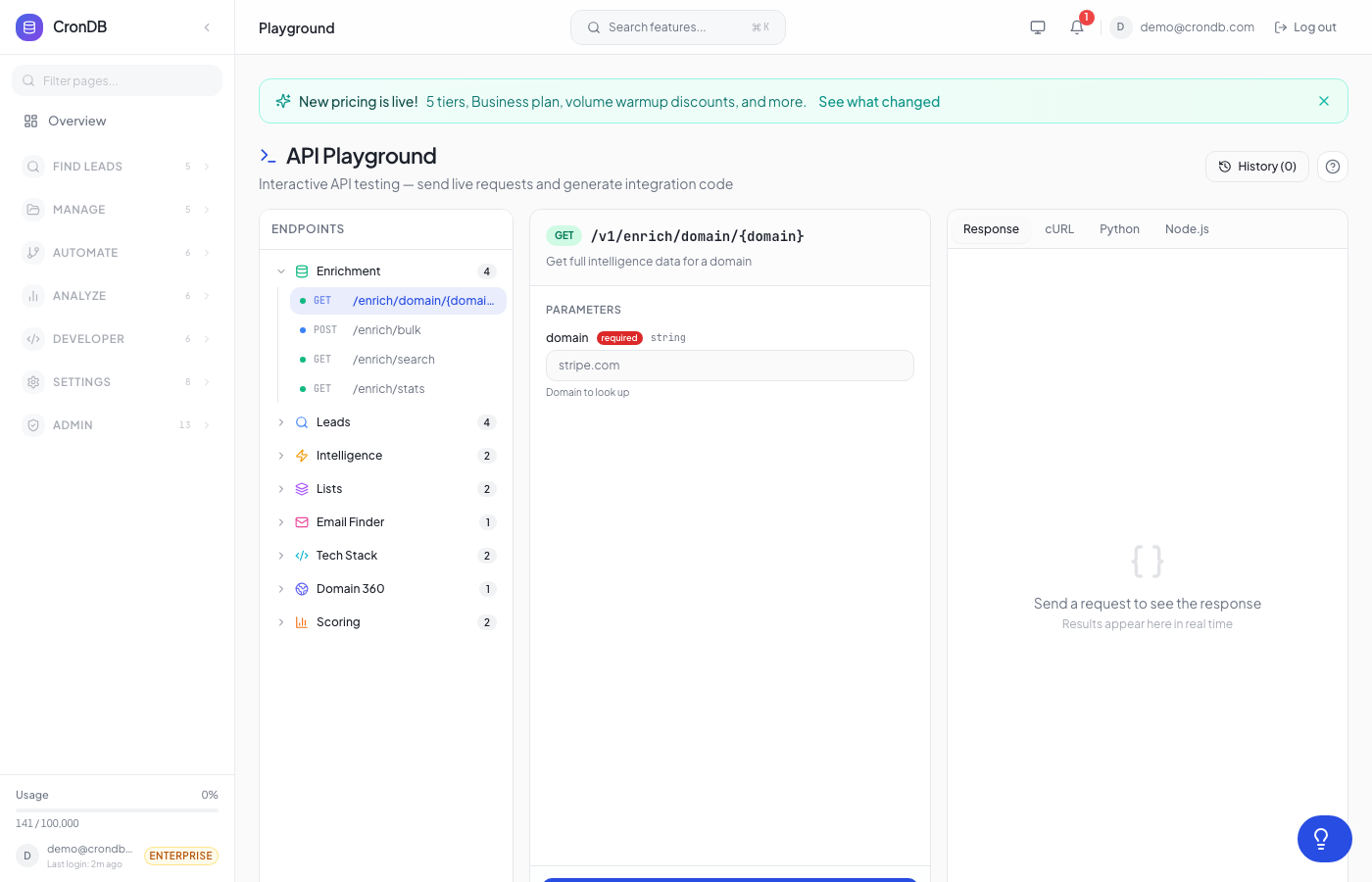
Try this endpoint live in the API Playground.
Requires Starter plan or above
The free plan does not include webhook access.
Endpoints
| Method | Endpoint | Description |
|---|---|---|
| GET | /v1/webhooks | List your webhooks |
| POST | /v1/webhooks | Create a webhook |
| PUT | /v1/webhooks/{id} | Update a webhook |
| DELETE | /v1/webhooks/{id} | Delete a webhook |
| GET | /v1/webhooks/deliveries | List all deliveries |
| GET | /v1/webhooks/{id}/deliveries | List deliveries for a webhook |
| POST | /v1/webhooks/{id}/deliveries/{delivery_id}/retry | Retry a failed delivery |
Plan Limits
| Plan | Max Webhooks |
|---|---|
| Free | 0 |
| Starter | 2 |
| Pro | 10 |
| Enterprise | 50 |
Create Webhook
POST /v1/webhooks
| Parameter | Type | Required | Description |
|---|---|---|---|
url | string | Yes | HTTPS endpoint URL |
events | string[] | Yes | Event types to subscribe to (max 20) |
curl -X POST \
  -H "Authorization: Bearer cdb_your_api_key_here" \
  -H "Content-Type: application/json" \
  -d '{
    "url": "https://yourapp.com/webhooks/crondb",
    "events": [
      "alert.domain_matched",
      "watchlist.domain_changed",
      "sequence.email_replied"
    ]
  }' \
  "https://api.crondb.com/v1/webhooks"
import requests

response = requests.post(
    "https://api.crondb.com/v1/webhooks",
    headers={"Authorization": "Bearer cdb_your_api_key_here"},
    json={
        "url": "https://yourapp.com/webhooks/crondb",
        "events": ["alert.domain_matched", "sequence.email_replied"],
    },
)
webhook = response.json()
print(f"Webhook ID: {webhook['id']}, Secret: {webhook['secret']}")
Response (201)
{
  "id": 1,
  "url": "https://yourapp.com/webhooks/crondb",
  "events": ["alert.domain_matched", "sequence.email_replied"],
  "secret": "whsec_abc123...",
  "is_active": true,
  "created_at": "2026-03-22T10:00:00Z"
}
Save the Secret
The webhook secret is shown only once. Use it to verify webhook signatures.
Available Events
| Event | Trigger |
|---|---|
search.alert | Saved search finds new matches |
keyword.match | Tracked keyword detected |
audience.updated | Audience has new matching domains |
domain.new_match | New domain matches your criteria |
domain.enriched | Domain enrichment completed |
intent.high_detected | High-intent domain detected |
watchlist.change | Watched domain data changed |
list.item_added | Domain added to a lead list |
list.status_changed | List item funnel status changed |
export.completed | Export job finished |
sequence.replied | Sequence email received a reply |
sequence.bounced | Sequence email bounced |
sequence.opened | Sequence email was opened |
sequence.clicked | Sequence email link clicked |
sequence.completed | Contact finished all sequence steps |
sequence.unsubscribed | Contact unsubscribed |
* | Subscribe to all events |
List Deliveries
GET /v1/webhooks/deliveries
View delivery history with success/failure stats.
| Parameter | Type | Default | Description |
|---|---|---|---|
webhook_id | integer | null | Filter by webhook |
event_type | string | null | Filter by event |
limit | integer | 100 | Max results (max 200) |
Response
{
  "deliveries": [
    {
      "id": 42,
      "webhook_id": 1,
      "event_type": "alert.domain_matched",
      "url": "https://yourapp.com/webhooks/crondb",
      "status": "delivered",
      "status_code": 200,
      "attempt": 1,
      "created_at": "2026-03-20T14:30:00Z"
    }
  ],
  "summary": {
    "total_delivered": 156,
    "total_failed": 3,
    "success_rate": 98.1,
    "avg_response_ms": 245
  }
}
Retry Failed Delivery
POST /v1/webhooks/{webhook_id}/deliveries/{delivery_id}/retry
Re-attempt delivery for a failed webhook. CronDB uses exponential backoff for automatic retries, but you can manually trigger a retry.
curl -X POST \
  -H "Authorization: Bearer cdb_your_api_key_here" \
  "https://api.crondb.com/v1/webhooks/1/deliveries/42/retry"
Webhook Payload Format
All webhook payloads follow this structure:
{
  "event": "alert.domain_matched",
  "timestamp": "2026-03-20T14:30:00Z",
  "webhook_id": 1,
  "data": { ... }
}
Headers included with each delivery:
| Header | Description |
|---|---|
Content-Type | application/json |
X-CronDB-Event | Event type |
X-CronDB-Signature | HMAC-SHA256 signature |
X-CronDB-Delivery-ID | Unique delivery ID |
Verifying Signatures
Verify webhook authenticity using the HMAC-SHA256 signature:
import hmac
import hashlib

def verify_webhook(payload: bytes, signature: str, secret: str) -> bool:
    expected = hmac.new(
        secret.encode(),
        payload,
        hashlib.sha256,
    ).hexdigest()
    return hmac.compare_digest(f"sha256={expected}", signature)
const crypto = require("crypto");

function verifyWebhook(payload, signature, secret) {
  const expected = crypto
    .createHmac("sha256", secret)
    .update(payload)
    .digest("hex");
  return signature === `sha256=${expected}`;
}
Next Steps
- Webhook Events — Detailed payload schemas for each event
- Alerts — Set up alert rules
- Watchlist — Monitor domains for changes